Tidlegare arrangement - Side 121
Abstract: The concept of symmetry breaking is well-known in physics, for instance in condensed matter, where it results from interactions in a many-body system — e.g., phase transition in a spin system. Yet, as physicists, we tend not to think of the patterned structures seen in living, many-body systems in terms of broken symmetries. Whether it is the spacing of knuckles on our hand, the collective alignment of hairs on an insect wing, or more globally the transformation of a homogeneous, isotropic embryo into a developed organism, symmetry breaking abounds in biology. What new insights can a physicist bring to understand the origin of these complex phenomena? (Click title to read full abstract below...)
How did two physicists end up working at Norway’s largest bank? Milan completed his PhD in experimental physics at the University of Western Australia in 2007, while Vilde did her master degree in computational physics at the University of Oslo in 2018.
Hylleraas seminar, hosted in Oslo
Abstract: Elimination of substances from the brain is believed to occur by a combination of convection and diffusion. In previous work, transport along perivascular spaces around blood vessels have been explicitly meshed and modeled, and also 1D-3D models have been used to model the interaction between blood and brain tissue. A problem with both these approaches is that it requires spatial information of all blood vessels within the brain and in addition may result in a computationally expensive system to solve. In this talk, I will introduce a homogenized model of transport in the brain, also taking into account transfer between different compartments (like blood and brain tissue) within the brain. Fluid flow in and between compartments are modeled with the mulitple-porosity elasticity theory (MPET), while transport within and between compartments are modeled with convection-diffusion equations. I will further show preliminary results from our model and compare with experimental data obtained in a glioma (brain tumor) patient, where transport between blood and brain is typically altered.
This talk is part of the Mechanics Lunch Seminar series. Bring-your-own-lunch and lots of questions.

Federico Urban, Institute of Physics, Czech Academy of Sciences.


Hylleraas seminar, hosted in Oslo
Vestlig statsfeminisme blir ofte beskyldt for å ha et snevert fokus på hvithet, cishet, heteroseksualitet og friskhet. I dette arrangementet ønsker vi å belyse at de fleste av oss befinner oss i en flytende kompleksitet som varer livet ut, der kroppene våre kan forandre seg og identitetskategorier vi kan ta for gitt, endres. Dette medfører livslang læring både om oss selv, og i samspill med andre mennesker og med våre omgivelser.

SPARK Norway Educational Forum are monthly open meetings organized by UiO:Life Science and SPARK Norway partners.

Nå kan vi gå tilbake til ordinær skoleeksamen, men vil vi det?
This Wednesdays Karl Henrik will talk about the programming language Julia and exciting things which can be done with this programming language.
Karl Henrik is working on Machine learning applied to quantum mechanical problems for his MSc thesis.
Marcos Caballero: Integrating computation in American high schools - a tale of resourcing, federalism, and equity
Tor Ole Odden: Everything can be a vector! An approach to teaching machine learning to early physics students?
Every second Tuesday, CBA staff gather for lunch and a talk. On October 12, it will be given by Cathrine Gundersen from NIVA and is entitled: Dirt and light - describing dissolved organic matter with fluorescence EEM PARAFAC.

Now it's time for the traditional Section 3 PhDs' & postdocs' gathering, which will take place in Abels Utsikt on October 12th, 2021, 09.30 - 16.30. All PhD students and postdocs have the opportunity to give a 15-minute talk on their research. In addition, Andrey Pilipenko (National Academy of Sciences of Ukraine/Igor Sikorsky Kyiv Polytechnic Institute) will give a talk on solving ODEs with non-Lipschitz coefficients by perturbation and Hao Tang (UiO) will introduce his research on stochastic fluid models. Welcome!
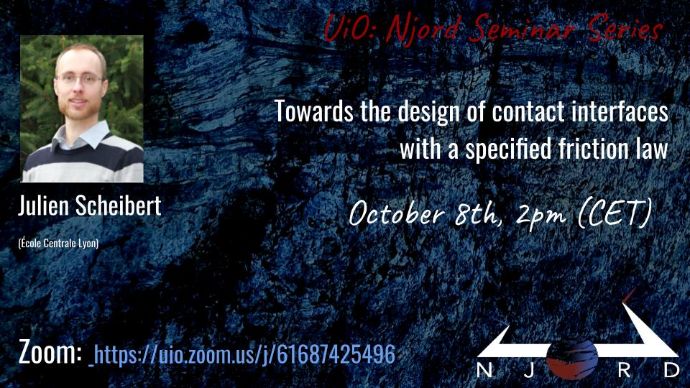
Julien Scheibert (École Centrale Lyon): Towards the design of contact interfaces with a specified friction law

Odd Petter Sand will defend his thesis Integrating Computing with Mathematics and Science Education: Case Studies of Student Understanding and Teaching design for the degree of Philosophiae Doctor.
Ph.d.-kandidat Ainar Drews ved Institutt for teoretisk astrofysikk, Det matematisk-naturvitenskapelige fakultet, vil forsvare avhandlingen "On microjets in sunspot penumbrae" for graden Philosophiae Doctor.
Abstract: My soft matter research group investigates the autonomous transformation of phospholipid agglomerates into membrane compartments through a sequence of topological changes on solid interfaces. This process is initiated by contact and wetting of artificially created as well as natural surfaces by the lipids, and proceeds via a network of interconnected lipid nanotubes to produce nearly uniform lipid bilayer compartments. Under minimal assumptions it is conceivable that such process could have occurred on the early Earth, where the autonomous formation of simple membrane compartments is presumed to have enabled encapsulation of nucleotides and prebiotic chemistry precursors. According to the currently accepted “bulk hypothesis”, such compartments have spontaneously formed under moderate environmental conditions from lipids suspended in bulk aqueous medium. Only very recently, surfaces have emerged as potential supporting structures for the self-assembly of prebiotic compartments. In my talk, I will report on new evidence for the involvement of surfaces in protocell nucleation and development. The talk will highlight the implications of the new findings for our understanding of possible origin of life processes, and argue that materials properties-driven autonomous processes on solid interfaces might have greater role in the development of life than currently considered.
Stable polynomials are a multivariate generalization of real-rooted univariate polynomials. This notion of stability for hypersurfaces can be extended to lower-dimensional varieties, giving rise to positively hyperbolic varieties. I will present results showing that tropicalizations of positively hyperbolic varieties are very special polyhedral complexes with a rich combinatorial structure. This, in particular, generalizes a result of P. Brändén showing that the support of a stable polynomial must be an M-convex set.

Doctoral candidate Carl Martin Rosenberg at the Department of informatics, Faculty of Mathematics and Natural Sciences, is defending the thesis Supporting Continuous Engineering with Unsupervised Log Analysis for the degree of Philosophiae Doctor.
Joao Inacio is MSc student CS:Physics 1st year. After the seminar we will have pizza.

The Information System Seminar Series features, Thomas Hylland Eriksen, Professor of Social Anthropology, UiO.

Ph.d.-kandidat Souvik Bose ved Institutt for teoretisk astrofysikk, Det matematisk-naturvitenskapelige fakultet, vil forsvare avhandlingen "On the dynamics of spicules and mass flows in the solar atmosphere" for graden Philosophiae Doctor.
Marginal maximum likelihood estimation of longitudinal latent variable models for ordinal observed variables is challenging due to the high latent dimensionality required to accurately model residual dependencies for repeated measurements. We use second-order Laplace approximations to the high-dimensional integrals in the marginal likelihood function for longitudinal item response theory models and implement an efficient estimation method based on the approximations. The method is illustrated with items from the Montreal Cognitive Assessment, administered at four time points in a Hong Kong study of aging and well-being. We discuss the limitations of the proposed estimation method and outline a potential extension to the approach that uses a dimension-reduction technique.