Events - Page 4
Daniel Johan Aarstein:
Within fluid mechanics, most interesting phenomena occur on the boundary between fluids of different densities, i.e. water+air, water+oil. Adding the constraints that the two fluids are insoluble, in addition to having the system take place in a pipe, we might experience what is known as a "slug".
Experimental and numerical study of slug behavior is a field within itself, this thesis aims to be a proof-of-concept that a novel, non-intrusive Deep Learning model can be used for real-time analysis. The model itself utilizes a Convolutional Neural Network in order to classify, and predict properties for a given slug in a pipe, based solely on acoustic emission from said pipe.
Current findings indicate that the classification on unseen data has an accuracy of ~93 %. The regression for velocity and length is, however, less precise with R2 scores of ~0.5 and ~0, respectively.
João Inácio:
The field of low-dimensionality magnetism has developed into an active area of solid-state physics, attracting both theoretical and experimental researchers. Due to the vast array of theoretical tools, there is a large effort to develop a full theoretical understanding of one-dimensional (1D) systems. A large part of this interest is due to nonequilibrium dynamics, where steady-state transport is a generic example.
Many physically relevant 1D models are Bethe-ansatz integrable, such as the spin-1/2 XXZ-model and the Fermi-Hubbard model, but computing transport coefficients still poses a great challenge. Moreover, little is currently known about transport properties of non-integrable models, such as the spin-S XXZ-model or ladder spin systems.
Omid Mirmotahari: For feedback processes to be enhanced, students need both appreciation on how feedback can operate effectively and strategies to use feedback within the curriculum. Several studies that examined feedback exchanged during student peer-review process have shown some challenges regarding students’ confidence in their own knowledge to perform assessment.
It has also been found that, due to students’ negative perception of their own level of competence, they have limited confidence in their fellow students assessing their assignment. Lack of clarity about assessment criteria and standards are a source of anxiety for many first-year university students.
Maria Vetleseter Bøe: We need students to engage in the learning activities that work. However, many students resist active learning activities and believe they learn more from traditional lectures.
We have studied how students’ motivation interacts with different learning activities, using focus group data from Norwegian physics students.
The findings suggest that students develop forms of motivation that promote learning in active learning situations when they feel competent, either through mastery, perceived learning, or comparison with peers, and that relatedness to a community of learners often helps enable development of such motivation.
Sakarias Frette: The standard model is the most accurate theory to date, with incredible precision measurements done at multiple detectors. It has however some shortcommings, not being able to explain phenomena such as the hierarchy problem, gravity, dark matter, etc.. Additional theories have been put forward to try to cover these issues, but for now, it has yielded no luck.
The strategy until recently has been to take such a model, and do a targeted search, resulting in large exclusion plots and no new physics. This is effective and fast for a single model, but very biased, and takes a lot of time if you want to try on 100 og 1000 models.
My thesis will instead try to apply a semi unsupervised technique to separate out anomalous data such that we can reduce the uninteresting SM background and focus on possible new physics that might be hidden in the data. The data analysis model used is an autoencoder.
Ben Zwickl from Rochester Institute of Technology is back an even week:
This is an in-progress project, and I’m looking forward to an interactive discussion with lots of questions and feedback!
Our team has conducted 16 interviews with scientists from chemistry, physics, biology, and mathematics. Each interview delves into important tasks that incorporate computation as part of doing research and/or teaching.
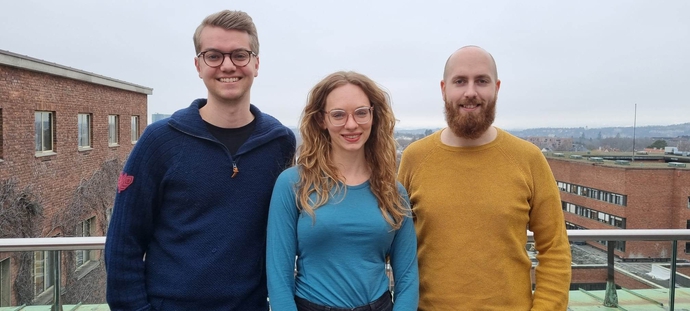
Henning V. Myhrehagen, Karl Henrik Fredly, and Hannah Christine Sabo are working on separate research projects in Tor Ole Odden’s research group at CCSE. Their projects address computation/programming in different parts of physics education. Here are the abstracts of the three lightning talks they will give:

To many, chatbots represent a challenge to academic integrity. However, what if instead of having teachers assess AI-written texts, we’ll have AI assess students? The talk will be an exploration and discussion on how existing and coming technologies opens a door to personalized learning.
Niklas Karlsen: How do we prepare pre-service teachers to teach the use of programming in a subject-specific context? Should they first learn programming independently of subjects? How do they navigate the challenges related to the learning and teaching of programming? How can programming be integrated into subjects?
This ODD seminar is a continuation of the previous discussion on computational literacy. For those of you who did not read out previous abstract:
Within the past decade, computation has become increasingly prevalent in school standards and curriculum across the world. One framework, computational thinking, has arisen as the dominent framework in educational settings.
Physics education at university level aims to equip students with the necessary skills to take diverse careers paths successfully and adapt to demands of a 21st century society rapidly and effectively. We consider that this can only be achieved by incorporating research-based education innovations that have equity, diversity and inclusion at their heart. In this talk I will present a design of interactive lectures that contribute to a more equitable, diverse and inclusive classroom environment. This goes hand in hand with the design of alternative assessments such as collaborative exams.
Collaborative exams not only can measure the previously gained learning, but also can be an optimal opportunity to produce new learning while reducing exam anxiety. We developed an inclusive approach for collaborative exams adjusting the design to the individual learning requirements of the students. In addition, we encouraged students to become active participants in the exam format by incorporating student-generated content.
In BIOS1100 we noticed that many of the errors students make are abstraction errors (not working at the correct abstraction level or translating incorrectly between levels of abstraction), and there seems to be some evidence of this in the research literature as well.
One way to approach this as an instructor (experts often unconsciously work on several levels of abstraction simultaneously) is to be explicit about which abstraction level we’re working at and when we make a switch – not only to further students’ understanding of the subject matter, but also to teach abstraction as a concept.
Geir Kjetil Sandve:
To teach introductory programming, one of the first choices one will face is which programming language to use. What criteria to use as a basis for this choice is however not obvious. I will briefly present some characteristics of the languages Java, Python and R that in my opinion influences their suitability for learning programming. This will be followed by an open discussion phase, where I hope that those attending would chime in with their experiences with learning or teaching programming to people from different backgrounds.
Quantum Computing: Machine Learning with Emphasis on Quantum Boltzmann Machines
Studies of Quantum Dots using Neural Networks and Coupled Cluster
Heather J. Lewandowski:
Quantum sensing, quantum networking and communication, and quantum computing have attracted significant attention recently, as these quantum technologies could offer significant advantages over existing technologies.
In order to accelerate the commercialization of these quantum technologies, the workforce must be equipped with the necessary knowledge and skills.
Through a study of the quantum industry, in a series of interviews with 21 U.S. companies carried out in Fall 2019 and from a survey administered to 57 companies through the Quantum Economic Development Consortium (QED-C) in Fall 2020, we describe the types of activities being carried out in the quantum industry, profile the types of jobs that exist, and describe the skills valued across the quantum industry, as well as in each type of job
Welcome to a new Computational Science seminar. This coming Friday, we have the pleasure of having Lars Nordbryhn, who has, since 2018, been the Norwegian focal point for IBM's Quantum Computing program. Attached there is a poster to promote the event. Feel free to share it with whomever you feel would be interested.
Since the format for the talk might be slightly different than usual, there is no specific title/abstract this time.
Electrostatics in Mesoscale Simulations of Biological Membranes using the Hybrid Particle-Field Approach
Presentation (pdf)
Within the past decade, computation has become increasingly prevalent in school standards and curriculum across the world. One framework, computational thinking, has arisen as the dominent framework in educational settings.
However, computational thinking is a difficult concept to operationalize and has many different, conflicting definitions.
Another conceptualization of how students learn computation, computational literacy, presents a more straightforward definition. Computational literacy breaks computational skills into three pillars: material (programming-related), cognitive (translating between material and programming aspects), and social (communicating around computation and results).
First, we will present an introduction to the computational literacy framework. We will then have a discussion around computational literacy, its tranlsation to different fields, its affordances and constraints, and its potential uses in research and teaching settings.
Hannah Sabo and Fridjof Gjengset
Evaluating the Phase Behaviour of Silica Modeled by the Vashishta Potential Using Free Energy Methods
Nowadays, since almost anyone can post on social media, a strict distinction between source and consumer is no longer evident. As a consequence we are exposed to an exponential growing flood of misleading information produced by an uncontrollable crowd of often clueless creators. Although it is well understood that the spread of misinformation leads to fatal consequences, it seems impossible to manually sort dangerous content from the sheer volume of data published on a daily basis.
Natural language processing is widely used to automatically classify suspicious content. Here, the strategy is to create manually labeled training sets and train classifiers to detect the content of interest.
The TEAM-program is an educational intervention to provide team training for first-year medical and other healthcare students. The aim of the program is two-fold:
(1) To build trust and team skills among the students in order to develop an inclusive and collaborative learning environment.
(2) To prepare the students for their future roles as leaders, communicators and collaborators in an increasingly more complex healthcare system.
The core element is a two-day team seminar, inspired by the Program Seminars at the MN-Faculty, UiO, and the Learning-Team Retreat, at Perelman School of Medicine, UPenn.
The program is based on a step-wise, research-based model for building well-functioning teams, where each step is implemented through specific activities.
The development and execution of the program is facilitated by near-peer mentors, who follow their designated learning teams through the first year. The educational intervention is systematically evaluated and involves several research projects. Here I will present the program, share what we have learned so far and discuss future developments.
This week we have the pleasure of having Helga Bodahl Holmestad, Sigurd Holmsen and Øystein Høistad from SINTEF.
Helga is a senior researcher at SINTEF (with a PhD in particle physics) while Sigurd and Øystein are working on their master of science thesis with supervisors from SINTEF, using machine learning and AI.
They will talk about research and job possibilities at SINTEF (in particular summer jobs with deadline coming up soon for summer 2023, of interest to many of you) as well as topics for Master of Science projects and other job possibilities.
Helga and Øystein will focus on machine learning applied to real life projects (in particular in connection with civil engineering and large construction plans) while Sigurd will present a project on machine learning applied to learning physical laws.
The physics laboratory is a complex environment where students encounter the messiness of the real world, use scientific equipment, execute experimental procedures, make predictions using mathematical and computational models, and more. Despite their potential value, the lab experience can be negative or not effective, especially if the goals and outcomes are not well aligned.
This presentation uses Activity Theory (AT) to make sense of three very different laboratory environments: the “traditional lab”, RealTime Physics (a focus on conceptual learning), and Thinking Critically in Physics Labs (a focus on scientific abilities).
The presentation may be interesting to anyone who is developing or studying laboratory instruction in the sciences.
Physicists, computer scientists and mathematicians are increasingly joining the life sciences using their tools to help figuring out how life works.
Brain science is particularly attractive since we have a fairly good understanding of the principles for how individual nerve cells work and how they can be modelled. Now the challenge is to leverage this knowledge to help us understand how networks of thousands, millions and eventually billions of such nerve cells make us perceive, think and feel. In the seminar I will introduce the challenges, and in particular talk about how hundreds of European scientists in the EU Human Brain Project work together to address this formidable and exciting challenge which some call the "holy grail" of neuroscience.
The time-honored conventional lecture (“teaching by telling”) has been shown to be an ineffective mode of instruction for science classes. To enhance critical thinking skills and develop problem-solving abilities, collaborative group-learning environments have proven to be far more effective.
Plenary lecture 4: Elizabeth Gire, Oregon State University
26 years ago, the physics faculty at Oregon State University radically redesigned their physics majors into the Paradigms in Physics program. Since then, the Paradigms has grown into a user facility for physics education research and curriculum development.
In 2016, we embarked on Paradigms 2.0, a substantial revision to the original Paradigms courses. I will describe the features of our program, what we’ve learned about apprenticing new physicists, and future directions.
Plenary lecture 3: Heather Lewandowski, University of Colorado Boulder
Physics is an empirical science. Therefore, learning physics must include learning how to design and conduct experiments, analyze and interpret data, and revise models and apparatus.
Lab courses are a way for students to engage in these authentic physics practices. Our work looks to improve lab experiences by improving students’ competency with modeling of physical and measurement systems, troubleshooting skills, documentation practices, and views of the nature of experimental physics.
Plenary lecture 2: Brean Prefontaine, Michigan State University
In this introduction to informal physics education (IPER), we will explore the historical and current landscape of research looking at informal physics education spaces and public engagement in physics. We will talk about the different kinds of questions that researchers have and are currently exploring, including the kinds of questions that we are currently researching at Michigan State University.
Just like in other areas of PER, there are a variety of methods that people are using to explore these spaces. We will discuss what kinds of data are being collected within informal spaces and what methods can be used to explore that data. Additionally, in many instances within informal spaces, the researcher and practitioner role are intimately connected.
We will discuss these instances and the importance of researchers disseminated information in a usable manner to practitioners. Finally, we will discuss ways that informal physics spaces are evaluated both internally and externally. Throughout this overview of informal physics education research, I will share examples from my own graduate research and work as an external evaluator.
Anders Malthe-Sørenssen and Tor Ole Odden, University of Oslo
Computation is a cornerstone of modern scientific research, and consequently many universities are actively working to incorporate computational methods into their science courses.
At the University of Oslo, this work has been going since the early 2000s and currently all bachelor programs in mathematics and natural science integrate computing from day one.
For example, in the physics bachelor program, students learn computation in through coordinated mathematics, physics and, computer science courses, and computation is then threaded through most subsequent physics courses.
In this talk, we address the Norwegian educational context, challenges and experiences from establishing such a program, examples of how the program is implemented, and how we work to integrate computing in programs across contexts and across educational levels.
We will also discuss what we are learning through our research activities on how students build computational literacy, and how computation can support student conceptual understanding and epistemic agency.
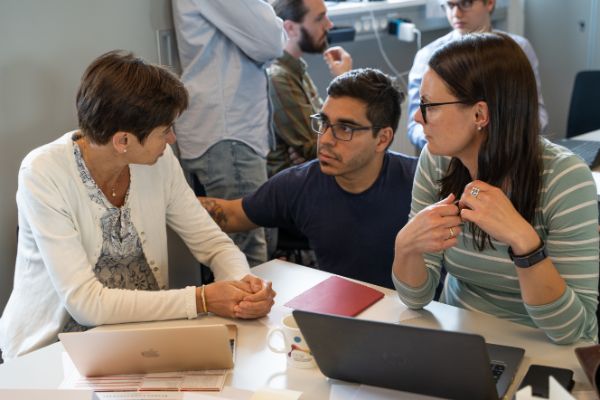
We would like to invite members of the physics education research groups of Michigan State University, University of Colorado-Boulder, and Oregon State University, as well as our Scandinavian PER colleagues, to a summer institute held in Oslo, Norway, and hosted by the Center for Computing in Science Education at the University of Oslo.
In this talk I report on my experiences in teaching programming for humanities students. I have taught this in a variety of ways, as a course for PhD and MA students in linguistics specifically, as a BA-level course in the honours program and as a general BA course for humanities students. The two latter courses were developed in collaboration with CCSE. I will try to say something about why programming is difficult for humanitites students, how it can be made easier and more relevant, and what worked and didn't work in our latest incarnation of the course.
Our world is increasingly computational. In the fields of science, mathematics, engineering, and technology the effects of this shift are well established and ongoing. But what does this mean for other fields, like the arts, humanities, the trades, or agriculture? I will kick off this session by presenting a few ideas and observations on the importance of expanding our notion of computational literacy outside of purely scientific and technical fields, based on my experiences growing up in a farming community and my family network of farmers. Then, we will shift gears to a discussion of what this lens of computational literacy might mean for a general pre-college education and how we can provide a computational education to students outside of traditionally technical fields.
Programming is a useful tool in several disciplines, but teaching programming in a disciplinary context can be quite different than teaching programming for computer scientists. How can we motivate students with different backgrounds to make sure that programming is perceived as relevant? And how does this affect what the students learn? We will talk about how we can teach programming for biologists, chemists, teachers and high school students, and what this teaching implies.
An obvious purpose of computer code is that it gives some desired results when executed on a computer. This is often the overarching focus in programming education, especially outside informatics programs. However, it is in most cases also desirable that code is easily readable and modifiable to humans - this e.g. makes it easier to eradicate bugs or to modify/extend code for new purposes. Many programmers in industry and science are thus arguing for improved programming practices, where the focus is not just on solving one given problem at a time, but on writing code that can be reused and extended to increase productivity in the long run. What is often not explicitly factored into such argumentation, however, is that both learning and applying good programming practices requires effort. This raises two core questions: what level of code quality is typically most pragmatic to aim for in science settings, and how valuable is it to spend course time on learning to improve code quality?
We have encouraged students to develop their own physics problems, explore them and report on their results in the form of a computational essay in the course in elementary electromagnetism (Fys1120) from 2018 to 2021. In parallel we have developed new learning material and supporting exercises to provide students with sufficient skills and knowledge to succeed with an essay project. In 2021 the computational essay project was used as an extended home exam counting 50% towards the final grade.
In this talk, I will discuss experiences and reflections on the use of computational essays and how we plan to develop this activity in the coming years.
Computational thinking (CT) has been added to many educational standards around the world. However, this new content presents challenges around preparing teachers to incorporate computational thinking into the STEM disciplines. In this talk, I will first give a review of the literature around preparing pre-service secondary STEM teachers to incorporate computational thinking into their subjects. I will then present data from interviews with pre-service secondary subject teachers in the STEM teacher education program at UiO . The data highlight a current gap in the research on teacher preparation: that the computation learned in upper division subject courses does not directly translate to the computational thinking that they will be teaching their future students. Finally, I give some suggestions for remedying this gap.
I will present a possible model for task design of mathematical programming problems (MPPs), where both the overarching design and a concrete example is given.
Following the implementation of the design into a mathematics classroom, I will present the students interactions when they were working on MPPs as well as a short analysis of the findings.
Finally, presenting the types of obstacles students encounter when working on MPPs and a discussion regarding the different types. There will be examples from the MPPs, experiences from the implementation, and questions/discussion throughout the module.
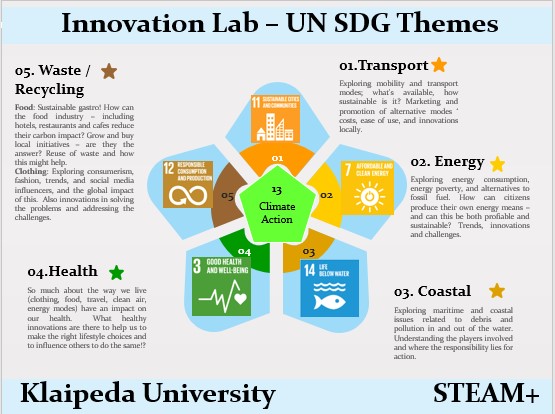
Please join our new digital transdisciplinary lab organized by our Klaipeda University partner. The main topic will be Sustainable Solutions for a Harbour City. We invite 3 to 5 students and one teacher to join our new transdisciplinary lab that will take place online during 22 of November-3 of December. The first 2 days students and teachers will attend lectures from different speakers and after that they will have to choose one or more topics from the picture under, identify such a challenge in the University campus and work together with others in order to find innovative solutions.
While “science practices” are featured heavily in current reform efforts, such efforts do not automatically result in opportunities for students to actively shape science knowledge practices.
When students are denied opportunities to shape science knowledge practices, and receive messages that their ideas, experiences, and communities are unscientific,philosophers name such harm as epistemic injustice.
To disrupt epistemic injustice, I use lenses from fields such as the History and Philosophy of Science to examine how students become transformative epistemic agents in their schools and communities by co-developing science knowledge and practices with teachers.
Teachers hold immense power in classrooms to open up or constrain opportunities for student learning.
While watching teachers enact equitable instruction is wonderful, we know that teachers are not born being able to help all students learn. How, then, can we prepare new teachers to enact equitable instruction?
Here, I will describe teacher educator pedagogies as we design and enact opportunities for preservice teachers to learn about, rehearse, and receive feedback regarding their emerging instruction. I will also describe design-based research conducted with preservice teachers to examine extended opportunities to rehearse equitable instruction in methods courses.
David Stroupe, en av forfatterne av boka Preparing science teachers through practice-based teacher education. Og her betyr ikke «practice» bare/først og fremst skolepraksis, men praksiser – altså ting læreren gjør i klasserommet – som fremmer læring, basert på boka Ambitious science teaching.
In US higher education—and especially the STEM (science, technology, engineering and mathematics) disciplines - women, first-generation college students, and students belonging to certain racial or ethnic groups enter exhibit greater attrition than do their male peers, a gap that continues throughout the professions.
In chemistry, students typically have their first encounter with quantum theory in a dense course covering an extremely broad range of topics to a somewhat shallow degree. Chemists require some knowledge of basic quantum theory, many body theory, time-dependent theory and spectroscopy.
BraketLab is a Python module being developed at the Hylleraas Centre of Quantum Molecular Sciences, which aims to provide a framework where the algebra and logic of quantum theory are automatically enforced, thus allowing the students to freely explore the quantum world and intuitively learn the rules while exploring.
I'll present the module, show some exercises and tutorials, and briefly share some experiences we've gained from teaching with it this semester.
How did two physicists end up working at Norway’s largest bank? Milan completed his PhD in experimental physics at the University of Western Australia in 2007, while Vilde did her master degree in computational physics at the University of Oslo in 2018.
This Wednesdays Karl Henrik will talk about the programming language Julia and exciting things which can be done with this programming language.
Karl Henrik is working on Machine learning applied to quantum mechanical problems for his MSc thesis.
Marcos Caballero: Integrating computation in American high schools - a tale of resourcing, federalism, and equity
Tor Ole Odden: Everything can be a vector! An approach to teaching machine learning to early physics students?
Joao Inacio is MSc student CS:Physics 1st year. After the seminar we will have pizza.
This week we have the pleasure of having Anne Marthine Rustad and Signe Riemer-Sørensen from SINTEF and the Mathematics and Cybernetics department.
SINTEF is a very important employer in our field of study and we look forward to hear about exciting research and job possibilities. Earlier this semester we forwarded several summer job options from SINTEF.
Philip Sørli Niane is master of Science student in CS:physics, 2nd year. Pizza thereafter and plenty of time for discussions. This is also a topic of interest for potential master of science thesis projects.