Tidlegare arrangement - Side 71
Hylleraas seminar, hosted in Oslo

Doctoral candidate Flore Kersten at the Department of Chemistry, Faculty of Mathematics and Natural Sciences, is defending the thesis "A double-edged sword. AB toxins as attack (cholera toxin) and defense (CCTX2) mechanisms" for the degree of Philosophiae Doctor.

Doctoral candidate Riccardo Parviero at the Department of Mathematics will be defending the thesis Statistical modelling of adoption processes on social graphs for the degree of Philosophiae Doctor.
What happens if we paint a steel box and put a water drop on it before it gets dry? The arcane curiosity arises: Will the paint remain the same or get destroyed? The answer is that it depends on the interaction between the surfaces and the length scale involved. My doctoral work was to study the stability of thin liquid films under aqueous drops. Slippery surfaces were used as a model system because they provide a frictionless surface with low contact angle hysteresis (<2°). We found that thin liquid films are stable on hydrophobic surfaces, while on hydrophilic surfaces, they rupture and dewet into droplets. We observed different dewetting patterns depending on the film thickness and slip. However, films on hydrophobic surfaces are stable but can be destabilized using external perturbations like an electric field. Due to the electric field, capillary waves are generated, and their evolution matches very well with a linear stability analysis. The reversible dewetting behavior with the applied field is an interesting observation of our work. With the applied frequency, the wavelength of the capillary waves does not follow the classical linear stability analysis; we modified the stability analysis, which agrees with our experimental findings. Finally, the coalescence of dewetted droplets and anomalous diffusive behavior with the applied external field will be discussed
INTED inviterer til «Collaborative Creativity»-workshop for studenter. Gjennom effektive brainstorming-teknikker får studenter erfaring med å tenke kreativt sammen med studenter fra andre disipliner.
Artem Basyrov, Cosmology and Extragalactic Astronomy research group, Institute of Theoretical Astrophysics, University of Oslo.
Tobias Dahl, Senior Researcher at SINTEF Digital and adjunct associate professor at UiO
Tittel: Achieving Data-efficient Neural Networks with Hybrid Concept-based Models

We welcome you to join the Kick-off of SMN's Strategic Thematic Area: Complex Oxide Electronics and Sensors
Velkommen til andre møte i Nettverk for maskulinitetsforskning, med tema maskulinitet og klima.
Justin Wells (SNM, UiO): Observing and understanding electron-boson interactions in solids

Professor Dag Trygve Eckhoff Wisland (NANO) wil present a seminar on the topic The path to battery-less, self-powered wireless IoT nodes.

Amin Doostmohammadi is an Associate Professor of Physics at the Niels Bohr Institute.

Doctoral candidate Andreas Oslandsbotn at the Department of Informatics, Faculty of Mathematics and Natural Sciences, is defending the thesis Scaling kernel-based learning for big data for the degree of Philosophiae Doctor.

Doctoral candidate Mahika Luthra at the Department of Chemistry, Faculty of Mathematics and Natural Sciences, is defending the thesis "Computational Study on the Electrochemical Reduction of CO2 using Transition Metal catalysts with Pendant Amines" for the degree of Philosophiae Doctor.
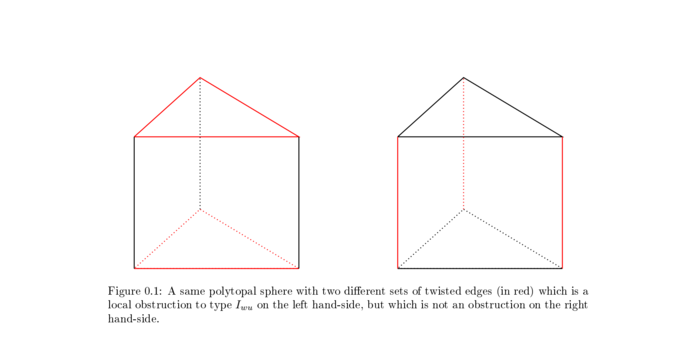
Phase tropical surfaces can appear as a limit of a 1-parameter family of smooth complex algebraic surfaces. A phase tropical surface admits a stratified fibration over a smooth tropical surface. We study the real structures compatible with this fibration and give a description in terms of tropical cohomology. As an application, we deduce combinatorial criteria for the type of a real structure of a phase tropical surface.
Phase tropical surfaces can appear as a limit of a 1-parameter family of smooth complex algebraic surfaces. A phase tropical surface admits a stratified fibration over a smooth tropical surface. We study the real structures compatible with this fibration and give a description in terms of tropical cohomology. As an application, we deduce combinatorial criteria for the type of a real structure of a phase tropical surface.
Phase tropical surfaces can appear as a limit of a 1-parameter family of smooth complex algebraic surfaces. A phase tropical surface admits a stratified fibration over a smooth tropical surface. We study the real structures compatible with this fibration and give a description in terms of tropical cohomology. As an application, we deduce combinatorial criteria for the type of a real structure of a phase tropical surface.
Physics of internal microstructure fluid flows plays important role both due to their applications as well as their more general research field. In most occasions this type of fluid flow problems are treated with discrete models that are both computational costly as well as unable to shed light into the more general physics of the problem. In this sense a continuous model in the Eulerian frame is adopted here that consists a generalization of the incompressible Navier-Stokes equation. The present model introduces an extra tensor in the governing equations that accounts for the angular velocity of the internal microstructure, namely the micropolar model.
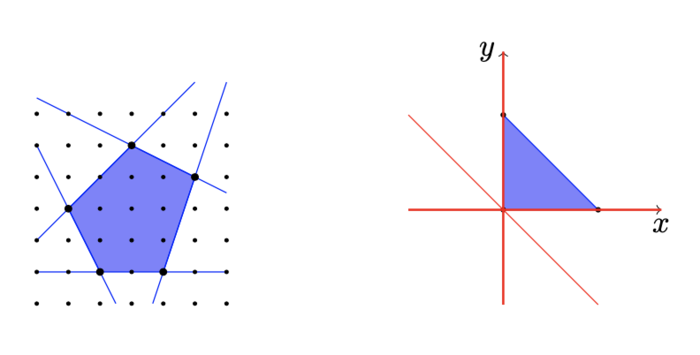
In 1962 Ehrhart proved that the number of lattice points in integer dilates of a lattice polytope is given by a polynomial — the Ehrhart polynomial of the polytope. Since then Ehrhart theory has developed into a very active area of research at the intersection of combinatorics, geometry and algebra.
The Ehrhart polynomial encodes important information about the polytope such as its volume and the dimension. An important tool to study Ehrhart polynomials is the h*-polynomial, a linear transform of the Ehrhart polynomial which is given by the numerator of the generating series. By a famous theorem of Stanley the coefficients of the h*-polynomial are always nonnegative integers. In this talk, we discuss generalizations of this result to weighted lattice point enumeration in rational polytopes where the weight function is given by a polynomial. In particular, we show that Stanley’s Nonnegativity Theorem continues to hold if the weight is a sum of products of linear forms that a nonnegative over the polytope. This is joint work with Esme Bajo, Robert Davis, Jesús De Loera, Alexey Garber, Sofía Garzón Mora and Josephine Yu.
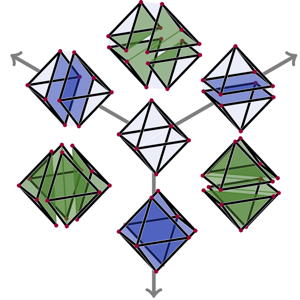
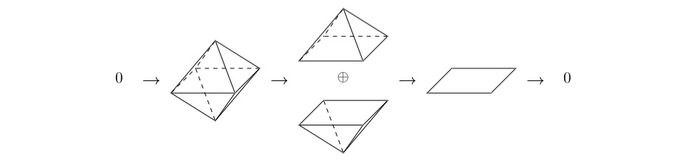
In this talk we define a new category of matroids, by working on matroid polytopes and rank preserving weak maps. This lets us introduce the concept of categorical valuativity for functors, which can be seen as a categorification of the ordinary valuativity for matroid invariants.
We also show that this new theory agrees with what we know about valuative polynomials: several known valuative polynomials can be seen as a Hilbert series of some graded vector space and we prove that these graded vector spaces let us define a valuative functor in the new sense.
Lastly, we sketch how to categorify a Theorem by Ardila and Sanchez, which states that the convolution of two valuative invariants (respectively, valuative functors) is again valuative.
This is based on a joint ongoing project with Ben Elias, Dane Miyata and Nicholas Proudfoot.