Tidlegare gjesteforelesninger og seminarer - Side 51
By Dr. Han Wang, Northwest Agriculture and Forestry University, Yangling and Tsinghua University, Beijing, China.
Jayant Joshi, Postdoc at Institute of Theoretical Astrophysics, UiO.
Waldhausen's algebraic K-theory of spaces is an extension of algebraic K-theory from rings to spaces (or ring spectra) which also encodes important geometric information about manifolds. Bivariant A-theory is a bivariant extension of algebraic K-theory from spaces to fibrations of spaces. In this talk, I will first recall the definition and basic properties of bivariant A-theory and the A-theory Euler characteristic of Dwyer-Weiss-Williams. I will then introduce a bivariant version of the cobordism category and explain how this may be regarded as a universal space for the definition of additive characteristic classes of smooth bundles. Lastly, I will introduce a bivariant extension of the Dwyer-Weiss-Williams characteristic and discuss the Dwyer-Weiss-Williams smooth index theorem in this context. Time permitting, I will also discuss some ongoing related work on the cobordism category of h-cobordisms. This is joint work with W. Steimle.
2 av 3 prøveforelesninger for professorstilling i transmisjons-elektron-mikroskopi (TEM).
Robert Hagala, PhD student, Institute of Theoretical Astrophysics, UiO.
By Erik Svensson, professor in evolutionary ecology at Lund University, Sweden.
Ada Ortiz-Carbonell, Researcher, ITA
I will review Witt vectors, KÀhler forms and logarithmic rings, and outline how they merge in the logarithmic de Rham-Witt complex. This structure gives an algebraic underpinning for the Hesselholt-Madsen (2003) calculation of logarithmic topological cyclic homology of many discrete valuation rings.
This talk is supposed to be an Introductionary talk to the preprint arXiv:1409.4372v4 (joint work with G.Garkusha). More specifically, using the theory of framed correspondences developed by Voevodsky, the authors introduce and study framed motives of algebraic varieties. This study gives rise to a construction of the big frame motive functor. It is shown that this functor converts the classical Morel--Voevodsky motivic stable homotopy theory into an equivalent local theory of framed bispectra, and thus producing a new approach to stable motivic homotopy theory. As a topological application, it is proved that for the simplicial set Fr(Delta^\bullet_C, S^1) has the homotopy type of the space \Omega^{\infty} Sigma^{\infty} (S^1). Here C is the field complex numbers.
Sven Wedemeyer, Researcher, Institute of Theoretical Astrophysics, UiO.
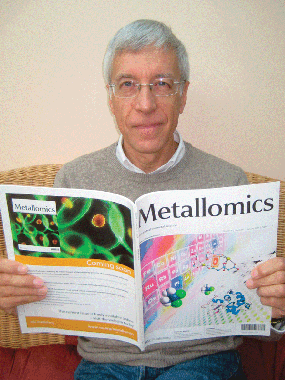
Biomedical seminar with Professor Wolfgang Maret, Kings College London, UK.
We will have a “mingle” meeting. There will be updates from Kristine and Per on the running of the institute. But fear not, there will also be plenty of time for informal chat and eating of cake. All are welcome to the lobby on the first floor.
I discuss how Bökstedt and Madsen (1994/1995) calculate mod p homotopy for THH(Z) and the fixed-point spectra THH(Z)^{C_{p^n}}, together with the R- and F-operators. This leads to a calculation for TC(Z; p) and K(Z_p), confirming the Lichtenbaum-Quillen conjecture in this case.
I will review Bökstedt, Hesselholt and Madsen's calculations of the topological cyclic homology of prime fields and the integers, again taking into account simplifications made in later papers. (If necessary, I will continue on Thursday.)
Nina J. Edin holder prøveforelesning i forbindelse med intervju for 1. amanuensisstilling i Biofysikk og medisinsk fysikk.
Recently two different refinements of Voevodsky's theory of presheaves with transfers were introduced: the first one is the theory of framed presheaves based on the unpublished notes by Voevodsky and developed by Garkusha and Panin and the second one is the theory of Milnor-Witt presheaves due to Calmes and Fasel. I will review some relations between these theories and explain that the hearts of the homotopy t-structures on the corresponding categories of motives are naturally equivalent. The talk is based on a joint work with A. Neshitov.
Steinar Midtskogen, Cisco Systems
In this third talk we will define Legendrian contact homology for Legendrian submanifolds in the 1-jet space of a smooth manifold M. Again, this will be the homology of a DGA generated by the double points of the Legendrian under the Lagrangian projection. The differential is defined by a count of punctured pseudo-holomorphic disks in the cotangent bundle of M, with boundary on the projected Legendrian. To prove that this indeed gives a differential we will use the theory of Fredholm operators from functional analysis. I will also say something about Floer theories in general. In particular, one of the main difficulties when defining Floer theories via pseudo-holomorphic curve techniques is to achieve transversality for the dbar-operator. There has been a development of several different machineries to solve these problems, for examle Polyfolds by Hofer et al., and Pardon's work on Virtual fundamental cycles. In our case, however, it is enough to perturb either the Legendrian submanifold or the almost complex structure.
Principal Investigator Jay F Storz, University of Nebraska.
Lluis Mas, PhD student, Institute of Theoretical Astrophysics, UiO