Tidlegare arrangement - Side 116
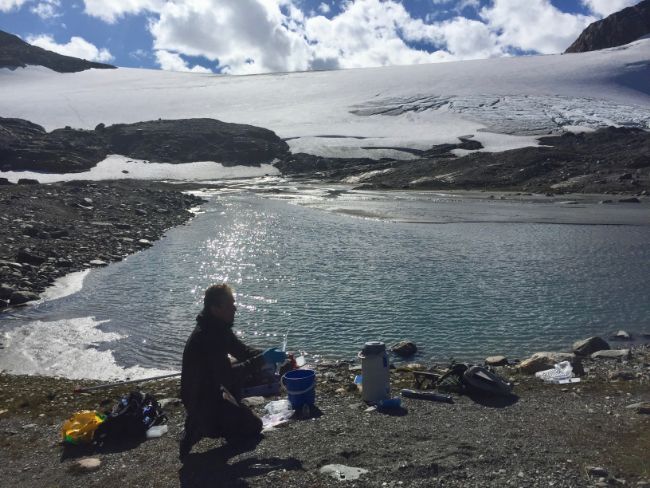
The Norwegian Environmental Chemistry Symposium Series builds upon a long lasting tradition of Norwegian conferences on environmental chemistry. After pausing of the conferences since 2013, they resurged as a continuous meeting series with NECS 2020 held in September 2020 in Loen, Norway. The new symposium series is organized under the auspices of the Norwegian Chemical Society´s Division for Analytical Chemistry.

Njord Seminar with Marcel Thielmann (University of Bayreuth): Crushed and fried: collaborative generation of deep earthquakes due to grain size reduction and shear heating
Hylleraas seminar, hosted in Oslo
Abstract: The fungal kingdom is one of the most species-rich organismal groups, containing up to 6 million species worldwide with a large diversity of ecosystem functions. Multicellularity has evolved independently in fungi, and over time many different growth forms and structures have originated. I will present some basics on fungal growth and the formation of complex multicellular structures.
Online participation is possible too. Please contact "timokoch at uio.no" for the Zoom link. This talk is part of the Mechanics Lunch Seminar series. Bring-your-own-lunch and lots of questions.

Tony Mroczkowski, European Southern Observatory (ESO), München.
SPARK Norway Educational Forum are monthly open meetings organized by UiO:Life Science and SPARK Norway partners.

Every second Tuesday, CBA staff gather for lunch and a talk. On January 25h 2022, it will be given by two CBA postdocs. Titl: Integrating hydrology and biogeochemistry in the high Arctic.

Research Seminar Series features, Yingqin Zheng, Senior Lecturer at Centre for Research into Sustainability, School of Business and Management, Royal Holloway, University of London, UK
Njord Seminar with Kristina Dunkel (University of Oslo): Earthquakes in the lower crust - origins and consequences

Vi ønsker studenter fra Det medisinske fakultet, Farmasøytisk institutt og Kjemisk institutt velkommen til informasjonsmøte om internshipordningen og muligheten for å søke sommerjobber i bedrifter.
This topic will be presented by Dag Wisland.

Njord Seminar with Osvanny Ramos (Université Claude Bernard Lyon 1): The LabQuakes project - from a granular fault to earthquake statistics

Every year in August and January we arrange REAL undervisning and REAL teaching as a kick-start of the semester with focus on teaching and learning.

Senter for tverrfaglig kjønnsforskning inviterer kolleger og venner til vårt årlige nyttårsselskap, som i år blir et digitalt arrangement. Det blir nyttårskåseri ved Ida Jackson og utdeling av pris for beste masteroppgave med kjønnsperspektiv.
Tittel:
Formalising Flows
Introducing Affine Extended Transformations and Flow-Structures
Kurset gir studenten kunnskap om vitenskapelighet i matematiske fag, og setter vedkommende i stand til å begynne arbeidet med en masteroppgave. Spesielt sentrale temaer i emnet er litteraturinnhenting, datahåndtering, skriving og presentasjon.
Seminaret finner sted online torsdag 13.januar 09:15-12:00 og fredag 14.januar 09:15-12:00. Lenke vil sendes ut på e-post.

Gruppearbeid og ulike undervisingssituasjoner hvor studenter skal jobbe sammen er nå en viktig del av høyere utdanning. Men det er ikke alltid lett å få gruppene til å fungere godt - både faglig og sosialt.

The Information System Seminar Series features, Tony Joakim Ananiassen Sandset, researcher at Center for Health Sciences Education, UiO

Doctoral candidate Flora Nah Asah at the Department of informatics, Faculty of Mathematics and Natural Sciences, is defending the thesis Challenges and Approaches of Implementing Standard Health Indicators in Hierarchical Organizations: A multi-sited study for the degree of Philosophiae Doctor.
Tittel: Compressed Sensing and Deep Learning
Investigation of stability properties for linear inverse problems

Tittel: Logarithmic Motives with Compact Support
Super-resolution is a hot topic in current day Machine Learning. The origin of the methodology dates back to applications in seismic imaging. I discuss the evolution from the early days and highlight some papers which have given new theoretical insights along the way. I illustrate the bridge between traditional convex optimization and current day convolutional neural nets. Along the way I show some examples where we have used this for current day applications in seismic imaging.