Tidlegare arrangement - Side 26

Lars-Anders Carlson is an associate professor at the Department of Medical Biochemistry and Biophysics, Umeå University. His main research interest lies in the drastic rearrangements of host-cell membranes that positive-sense RNA viruses carry out within hours of entering a cell.

Harsh Mathur, Rosseland Centre for Solar Physics, University of Oslo.

Doctoral candidate Paul Kobialka at the Department of Informatics, Faculty of Mathematics and Natural Sciences, is defending the thesis Data-driven Formal Methods for User Journey Analysis for the degree of Philosophiae Doctor.

What does reform in research assessment look like in practice? Join us in this Open Science Lunch for three different perspectives on implementing reforms in research assessment.

Boumediene is a Senior Scientist at the Department of Computing and Mathematical Sciences at Caltech, USA.
The NorMIC workshop series aims to teach biological researchers the principles of biological microscopy and image processing.

Doctoral candidate Hoa Thi Nguyen at the Department of Informatics, Faculty of Mathematics and Natural Sciences, is defending the thesis Continuous Learning and Adaptation in Autonomic Systems for Industrial Applications for the degree of Philosophiae Doctor.

Electric Wind: An Energy History of Modern Britain
For invited people.

Rich is a geologist, specialising in geochronology, geochemistry and microanalysis. He is currently working at Zeiss Microscopy in Cambridge, UK.
Hylleraas seminar, hosted in Oslo

Ambre Bouillant is a CNRS researcher, interested in phenomena that lie at the frontier between phase transitions, interfacial phenomena, and viscoelasticity. Her previous researches, mainly experimental, were focusing on the Leidenfrost effect, thermo-capillary stabilisation of thin films, the coalescence of viscoelastic droplets, and the condensation of vapours on deformable surfaces.

Anna Kathinka Dalland Evans, astrophysicist and editor at Store norske leksikon.

Welcome to a seminar for employees who will work in the Life Science Building.
Velkommen til seminar for deg som skal ha Livsvitenskapsbygget som arbeidssted.
C*-seminar by Are Austad (University of Oslo).

Har mannosfæren gnålt nok om gutteproblemet nå? Eller har tiår med feminisme gjort oss blinde for menns situasjon? Det er spørsmålene Snorre Rein stiller panelet når STK markerer Mannsdagen 19. november i Cafe Niels på Blindern. Det serveres kaffe, te og croissanter.
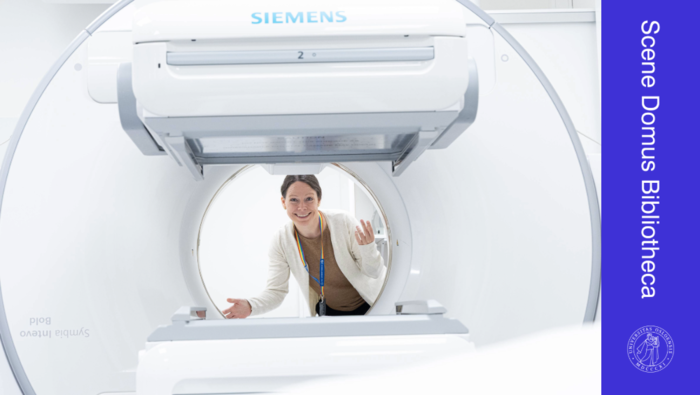
Radioaktive legemidler blir svært viktig i fremtidens kreftbehandling. Møt norske eksperter i verdenstoppen!

Jonas Wallin is an Associate Professor of statistics in the Department of Statistics at Lund University in Sweden. He is a mathematical statistician working with spatial statistics, Gaussian processes, optimisation and high dimensional regularisation.

PhD candidate Laurent Fontaine at the Department of Biosciences, Faculty of Mathematics and Natural Sciences, is defending the thesis 'Statistical Analysis and Modeling of Microbial Communities in Aquatic Ecosystems' for the degree of PhD.

Doctoral candidate Katherine Wyers at the Department of Informatics, Faculty of Mathematics and Natural Sciences, is defending the thesis Information Infrastructural Violence - A Critical, Intersectional Study of the Consequences of Gender Recategorization in Government Information Infrastructures for the degree of Philosophiae Doctor.
Joakim Bergli:
Quantum synchronization is often studied using a master equation, typically the Lindblad equation. This gives the time evolution of the density matrix. If we study the response to a periodic external signal, synchronization is detected by a steady state density matrix that is in phase with the external signal.
Students use AI. This can be beneficial, but it also creates challenges in the classroom. Careless use of AI can make students expose their sensitive data, bypass their own learning and harm their teachers' trust. Teachers see these risks, but lack the time explore AI tools themselves and develop effective pedagogy.

This talk details how we have come to understand the microbial ecosystem in sewage conveyance systems and the ways we use this information to track pollution in surface waters, identify risk and opportunity for wastewater treatment, and determine the role of urban wastewater systems in antimicrobial resistance dissemination.