Webpages tagged with «Barents Sea»
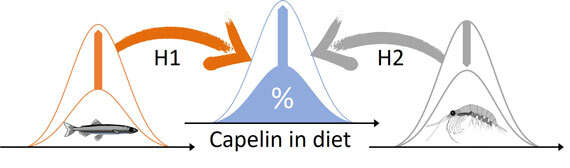
In a paper published in MEPS (Durant et al. 2026) we look at how important capelin Mallotus villosus are in the diets of major predators in the Barents Sea — including cod, haddock, saithe, minke whales, harp seals, kittiwakes, and guillemots — and how that importance changes when another key prey, such as krill, is more or less abundant.

With temperature warming, fish population are not only changing their foraging zone but also where they are spawning their eggs. While temperature can be beneficial for high latitude species it may also lead to some constraints. In their paper, Langangen et al (2025) studied the effect of changing spawning location for Atlantic cod in the Barents Sea.
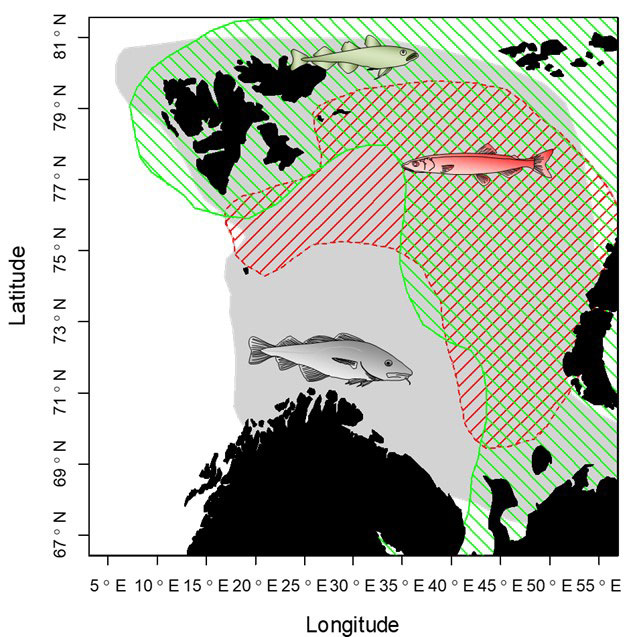
The Arctic is rapidly changing. The reduction of the sea-ice extent of the northern part of the Barents Sea is affecting the interactions between key fish species in this ecosystem. In a work published in The Proceedings of the Royal Society, Durant et al. studied the impact of these environmental changes on predator-prey relationships between cod, capelin and polar cod and ecosystem balance.
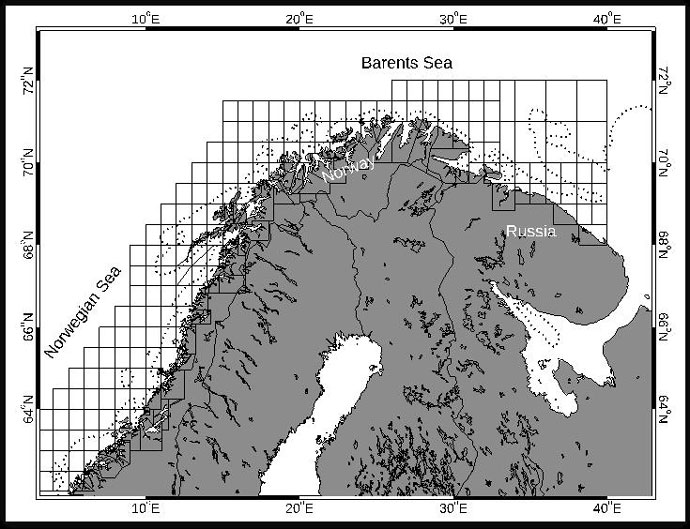
Climate change profoundly affects oceanographic conditions and the future distribution of many fishes. Climate change thus affects fisheries that are assumed to follow fish displacement. In a study published in npj Ocean Sustainability (Abe et al. 2024), we evaluate this assumption by analyzing a long-term, large-scale yet high-resolution dataset of Atlantic cod (Gadhus morhua) fishery in Norway combined with a detailed oceanographic model.

The Norwegian coast is a spawning hot spot for several highly valuable fishes. After hatching, the young fish drift, largely together, toward the Barents Sea. During this drifting period, they need to feed and are experiencing predation. In a paper published in Marine Ecology Progress Series (Ferreira et al. 2024) we explore the benefits and disadvantages of drifting together with other larvae.
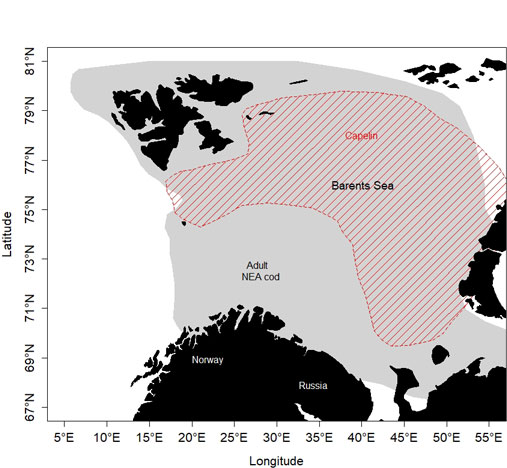
Understanding the changes in population abundance is essential to correctly manage and preserve the natural populations. Interaction between species, such as predation or competition, is an important factor affecting population dynamics. To understand population dynamics it is thus useful to study species interactions. In a recent study published in Biology Letters, we analysed the interaction between two iconic fish species of the Barents Sea: the capelin and the Atlantic cod.
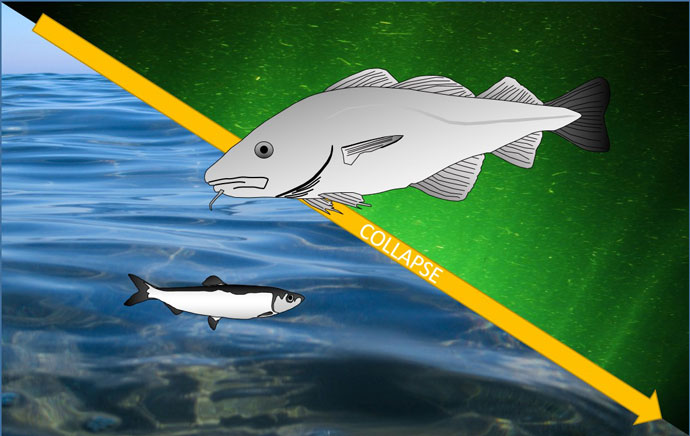
Over the last century, overfishing has led to the collapse of many fish stocks. Some of them, following successful management actions, have rebuilt their number but did they remain the same? In a recent study published in Ecology and Evolution we explored the effect of collapse on the stocks ecology by testing for differences before and after.

Jellyfish are usually not targeted by scientific surveys that focus on commercial fish stocks. However, they are very often found in the by-catch of egg and larval surveys. In a recent paper in ICES journal of Marine Sciences, we studied such by-catch data from surveys conducted between 1959-1993 in the Barents Sea showing the high value of such historic data.
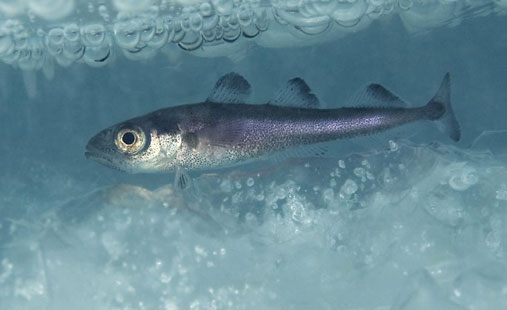
In the Arctic part of the Barents Sea, climate change is increasing temperature, melting the sea ice and bringing more predators. All these are a concern for the polar cod (Boreogadus saida) a key species in this food web. In a recent paper published in Marine Ecology Progress Series (Dupont et al. 2021) we explore which of these environmental factors has the most effect on polar cods.
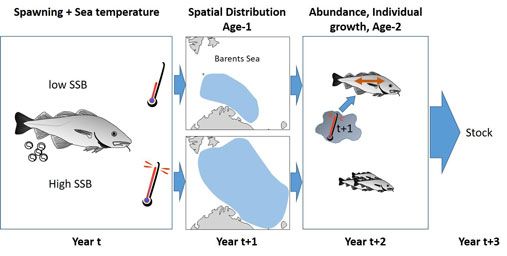
While the importance of early life survival and growth variations for population dynamics is well documented, there is still a relatively limited understanding of how survival and growth is affected by the species’ spatial distribution. In a study published in the ICES Journal of Marine Science, we analysed 24-years of indices of spatial distribution of 1 year old Northeast Arctic cod to study the role of distribution for the change in abundance and mean body size through their second winter of life.
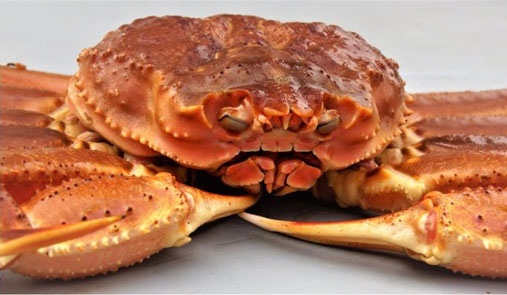
The snow crab (Chionoecetes opilio) is a newly established species in the Barents Sea, increasing in both distribution and abundance in recent years. In this Arcto-Boreal sea, they encountered the most abundant Atlantic cod (Gadus morhua) stock. What happens from here?
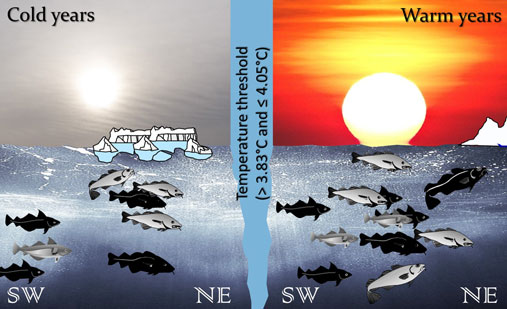
In the Boreal-Arctic seas, the two most abundant gadoid fish are the Atlantic cod (Gadus morhua) and the haddock (Melanogrammus aeglefinus). Both tend to respond to climate warming by an abundance increase and a change of distribution. Are these changes affecting how they are interacting? Statistical analysis using a state-space threshold model of acoustic and trawl survey data on cod and haddock abundance indicates that the interaction is changing with sea temperature: the cod negatively affecting the haddock when sea temperature is over 4 °C.
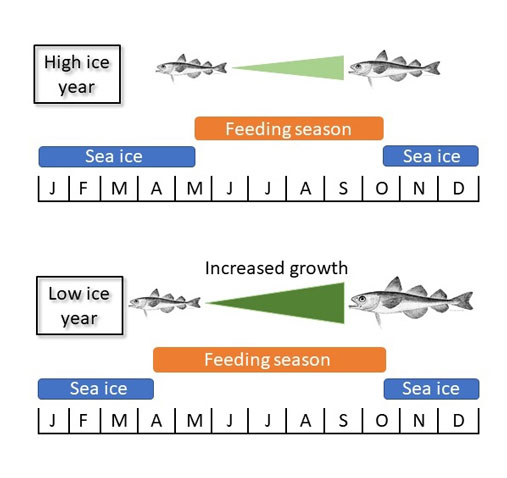
We studied the effect of changes in sea ice cover, sea temperature, and biomass of prey or predator on the length of polar cod. Our results show a significant negative effect of sea ice cover on length of all age groups of polar cod: Polar cod grow faster when there is less sea ice.
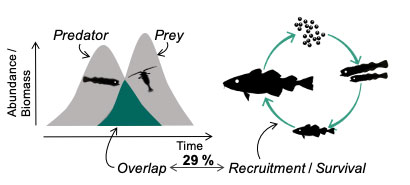
We assessed the effect of the predator−prey relationship on predator survival by developing a novel metric of predator−prey overlap using spatio-temporal statistical models. We found that the amount of overlap between cod larvae (length: 11−15 mm) and their prey explained 29 % of cod recruitment variability.
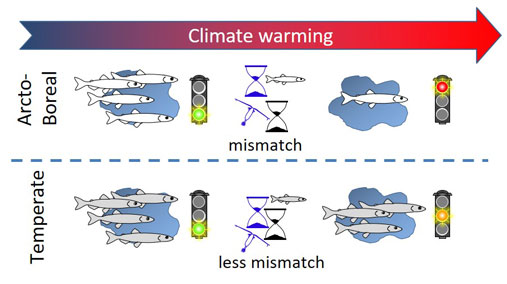
Climate warming is changing the timing of among others the reproduction for plankton or fish. Predators depend on an abundant prey supply to feed their young and insure that they survive. When the timing of the prey and the predator are not in synchrony the predator young cannot feed and are dying: there is a mismatch.
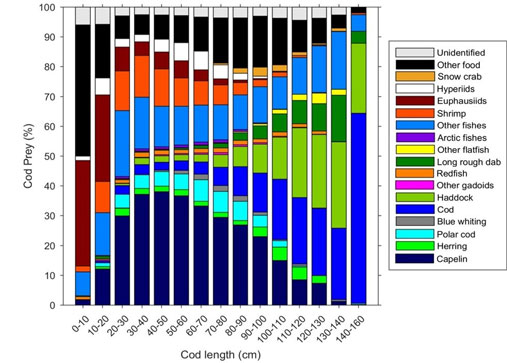
The Atlantic cod is one of the major predator in the Barents Sea estimated to consume over 5 million tonnes of fish in 2017. In a recent paper (Holt et al. 2019) we explore the diet of this species using a unique dataset encompassing 33 years of cod stomach sampling by Russian and Norwegian scientists. This time-series is the most comprehensive available cod diet dataset to date and is crucial in helping to answer ecologically important questions on what cod eat and why it matters for predator-prey and food-web dynamics in the Barents Sea ecosystem.

Where the fish are spawning is of tremendous importance for the population (see our post) but also for the industry relying on it, especially since harvesting is often concentrated on fish that aggregate for to spawn. Climate change and harvesting are known to strongly affect the fish population with effect on the spawning location. In a recent paper (Langangen et al. Global Change Biology) we explore the question: “who is the culprit of spawning location change: Climate or fishing?”
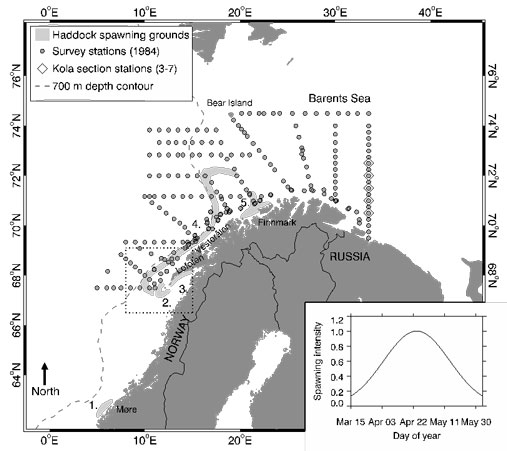
Spawning migration is a prevalent phenomenon for the major fish stocks in the Barents Sea. While many of them migrate to the coast of Norway to spawn they are doing so to different areas. We have studied the Northeast Arctic haddock variability in spawning grounds to understand what drives the observed shifts over time.
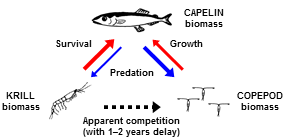
In a study recently published in Ecology we find apparent competition between major zooplankton groups in a large marine ecosystem. Apparent competition is an indirect, negative interaction between two species or species groups mediated by a third species other than their prey.
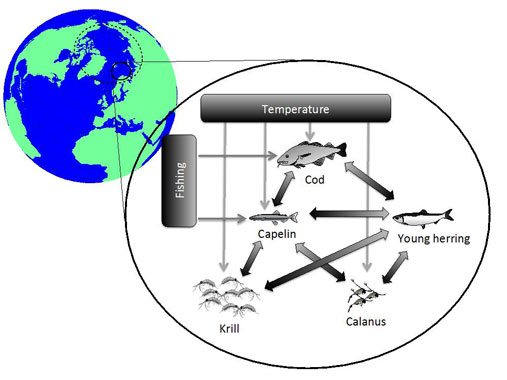
Mass mortality events are events that cause elevated mortality that may reduce the population size over a short period. Such events are likely on the rise across the globe and for several taxa (Fey et al. 2015). We recently investigated how such events may affect the community of interacting species in the Barents Sea. For this investigation, we constructed a multi-species model of a key component of the Barents Sea ecosystem consisting of fish and zooplankton
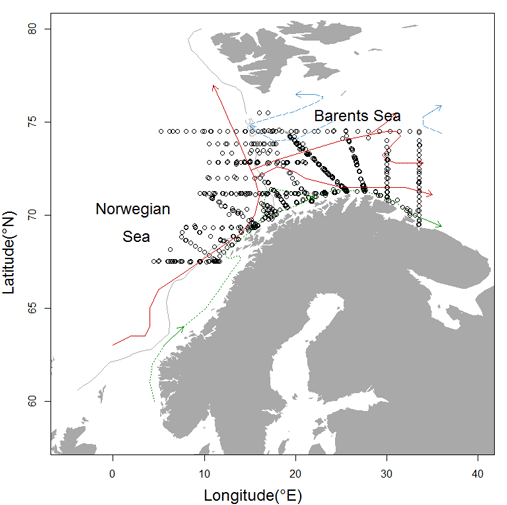
It is notoriously difficult to estimate mortality rates for zooplankton populations in the open ocean. In a new paper, Kvile and colleagues demonstrate that mortality estimation can be improved using a statistical regression approach (SRA) that takes into account advection and spatiotemporal trends in recruitment. Using this method on Calanus finmarchicus survey data from the Norwegian Sea–Barents Sea, they find indications of increased mortality for the oldest copepodite stage pair (CIV–CV), possibly reflecting higher predation pressure on larger copepodites.
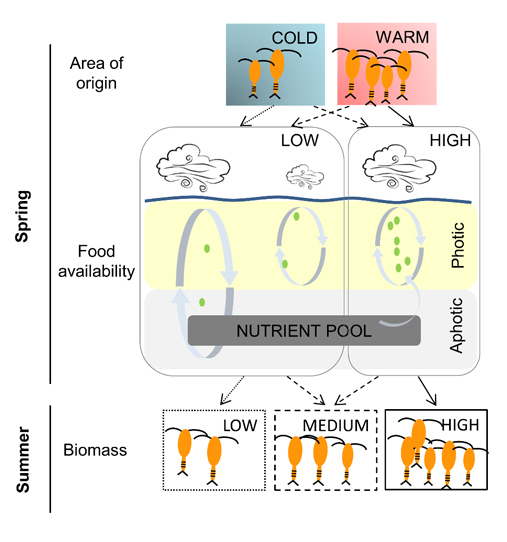
A recently paper published in PNAS, members of the CEES Marine Group explore potential climate effects on Calanus finmarchicus, a key zooplankton species in the North Atlantic. The paper shows how the combination of shallow mixed-layer-depth and increased wind apparently increases chlorophyll biomass in spring, and in turn C. finmarchicus biomass in summer. These findings strongly suggest bottom-up effects of food availability on zooplankton, and highlight the need to consider climate effects “beyond temperature” when projecting zooplankton dynamics under climate change.
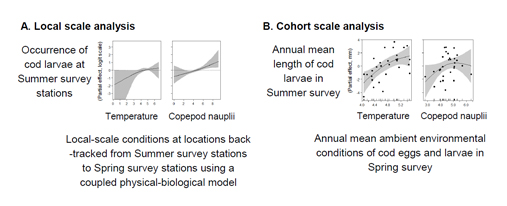
Many marine fishes experience tremendous mortality during their first months of life. Understanding the causes of this mortality and why it varies from year to year has challenged fisheries ecologists for more than a century. Part of the difficulty comes from the fact that many fishes have free-floating larvae. It is therefore difficult to follow a group of fish larvae over time in the field and investigate which factors cause mortality.
Since Hjort’s ground-breaking work, it is admitted that the survival from the egg to the first reproduction is an essential factor affecting the dynamics of fish populations (see post). Human activities around spawning ground may have an effect on the mortality of the younger age. One of such potentially risky activity is oil exploitation which is on the increase in the northern areas.

The year 2014 marks the 100th anniversary of the Norwegian oceanographer and biologist Johan Hjort’s ground-breaking work, Fluctuations in the great fisheries of northern Europe, viewed in the light of biological research. This anniversary was commemorated with a special issue of ICES Journal of Marine Science.