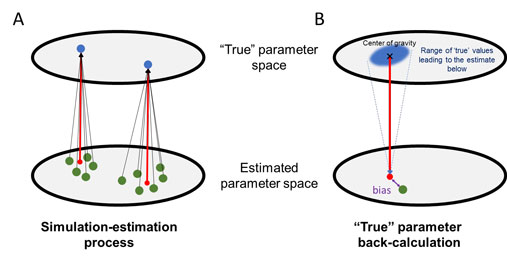
Conservation efforts and management decisions on the living environment of our planet often rely on imperfect statistical models. Therefore, managers have to brace for the uncertainty associated with the model and study system i.e., set their acceptable risk level, to make some decisions. However, risk estimates themselves can often be biased. In a recent paper published in Nature communications we demonstrate that one can back-calculate the correct value of risk by combining data fitting with an extensive simulation–estimation procedure.
Marine Science blog - Page 2
A new pan-arctic study indicates that Calanus copepods do not necessarily descend deep for diapause in winter; instead, parts of the population remain active. Moreover, the deeper distribution of the larger and more conspicuous Calanus hyperboreus indicates that predation pressure is a key trigger for diapause at depth. In the central Arctic Ocean where visual predation pressure is lower, copepods might be relieved from the incentive to descend and can remain closer to the surface in winter.
Extreme events in the marine environment, like marine heatwaves, are likely at least as important as changes in mean values for causing threats to biodiversity, with impacts on ecosystem services and consequences for human systems. The potential of human and natural systems to adapt to such changes remains unclear, but two recent articles in the high-impact journal PNAS look closer at the possibilities.
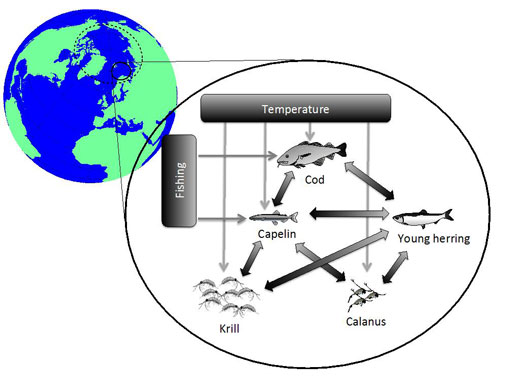
Population abundance depends on production of young and survival of adults. Assessing the contribution of young production to population growth and identify the main drivers of its variability may help to identify appropriate stock management measures. What happens when several stocks, belonging to different trophic levels and habitats, as well as having different exploitation histories are sharing the same environment?
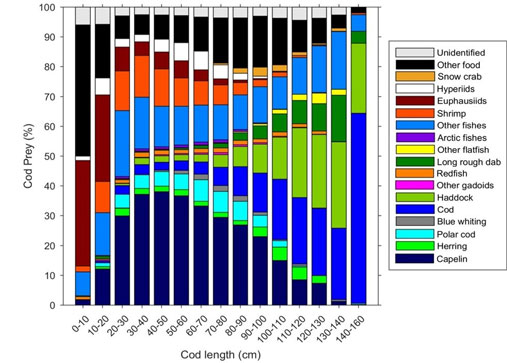
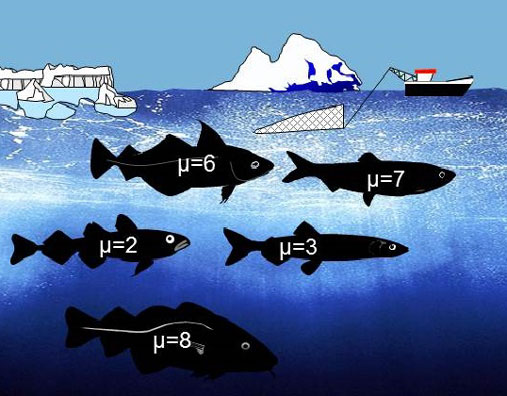
The Atlantic cod is one of the major predator in the Barents Sea estimated to consume over 5 million tonnes of fish in 2017. In a recent paper (Holt et al. 2019) we explore the diet of this species using a unique dataset encompassing 33 years of cod stomach sampling by Russian and Norwegian scientists. This time-series is the most comprehensive available cod diet dataset to date and is crucial in helping to answer ecologically important questions on what cod eat and why it matters for predator-prey and food-web dynamics in the Barents Sea ecosystem.
Climate effects on marine ecosystems are often projected as a bottom-up process. That is, the focus of the projections is often: How do changes in physical conditions and biogeochemical processes at lower trophic levels influence living conditions for fish and other organisms at higher trophic levels? However, this view ignores feedbacks between higher and lower trophic levels.
Where the fish are spawning is of tremendous importance for the population (see our post) but also for the industry relying on it, especially since harvesting is often concentrated on fish that aggregate for to spawn. Climate change and harvesting are known to strongly affect the fish population with effect on the spawning location. In a recent paper (Langangen et al. Global Change Biology) we explore the question: “who is the culprit of spawning location change: Climate or fishing?”
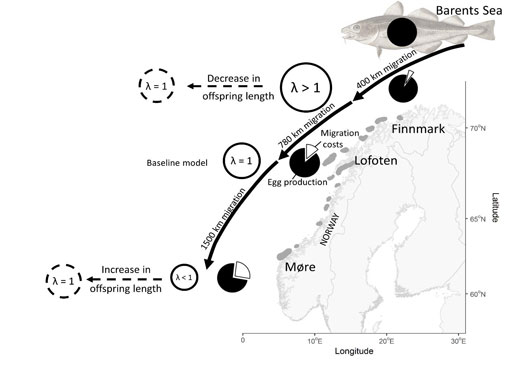
The extensive spawning migration of Northeast Arctic cod was suggested to be counterbalanced by increased early-offspring survival, however we find in a study published in July in Marine Ecology Progress Series, that early offspring growth should be considered as another factor explaining this long-distance migration.
Many heavily fished fish stocks are dominated by young and small fish. The reason is simple: the chance to reach old age is small. If the fisheries selectively target large fish, the dominance of young and small fish becomes even larger. Such skewed age and size distributions can make the fish populations more sensitive to detrimental effects of oil spills.
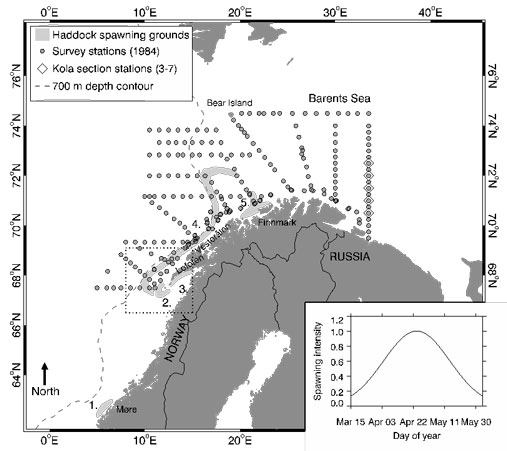
Spawning migration is a prevalent phenomenon for the major fish stocks in the Barents Sea. While many of them migrate to the coast of Norway to spawn they are doing so to different areas. We have studied the Northeast Arctic haddock variability in spawning grounds to understand what drives the observed shifts over time.
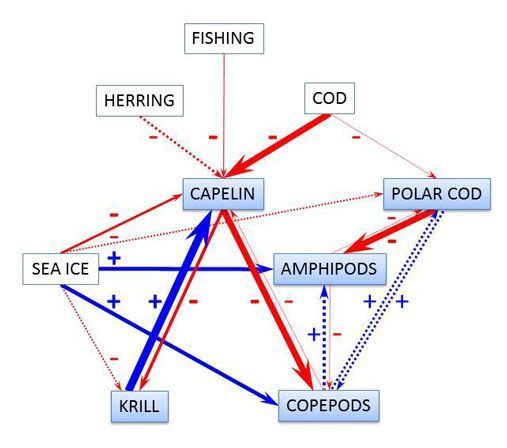
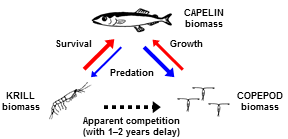
In a study recently published in Ecology we find apparent competition between major zooplankton groups in a large marine ecosystem. Apparent competition is an indirect, negative interaction between two species or species groups mediated by a third species other than their prey.
Since Hjort in 1914 it is accepted that recruitment variation is a major source of variability in the biomass of adult fish. In a recent study published in Marine Ecology Progress Series (Durant & Hjermann 2017) we investigated how external forcing and age structure alter the effect of the year-to-year recruitment variability on population growth for some key fish species which occupy different trophic levels in an Arcto-boreal marine ecosystem.
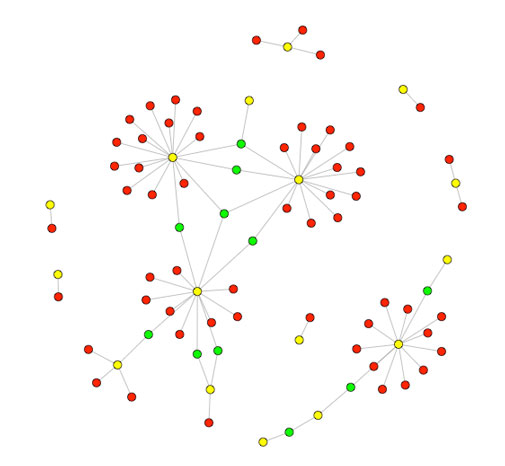
Conventional fishing management by governmental regulation often oversimplifies the complex interplay of power relationships between fishers and other stakeholders. In a recent study published in Ecology and Society (Kininmonth et al. 2017), we looked how the fishing-traders relationships may affect fishing patterns in light of market or ecological changes.
High fishing pressure tends to lead to proportionally fewer old and large individuals in fish stocks. It is feared that these demographic changes make the fish stocks more sensitive to climate variability and change. Statistical analysis of long-term survey data on cod eggs throws new light on the possible mechanisms.
In March 2016, a Memorandum of Understanding for Seas of Norden Research School (SEANORS) promoting collaborative marine research and training in the Nordic countries was signed by the rectors of 9 Nordic universities.
Spawning time and location are important factors affecting the reproductive cycle for migratory fish by potentially affecting offspring survival and growth. We examine this relationships by using a drift model for early life stages (eggs to age 1) of the Northeast Arctic cod combined with empirical estimates of spatial variation in mortality at two different life stages (Langangen et al. 2016).
The Marine Group of CEES was created in august 2005 as a platform where people with common interest meet and exchange ideas. In 2015 we were about 20 post-docs and PhDs financed on project money. I think it is time after more than a decade to look at the success and failure of our group, generally share experience, and maybe brag a little.
Mass mortality events are events that cause elevated mortality that may reduce the population size over a short period. Such events are likely on the rise across the globe and for several taxa (Fey et al. 2015). We recently investigated how such events may affect the community of interacting species in the Barents Sea. For this investigation, we constructed a multi-species model of a key component of the Barents Sea ecosystem consisting of fish and zooplankton
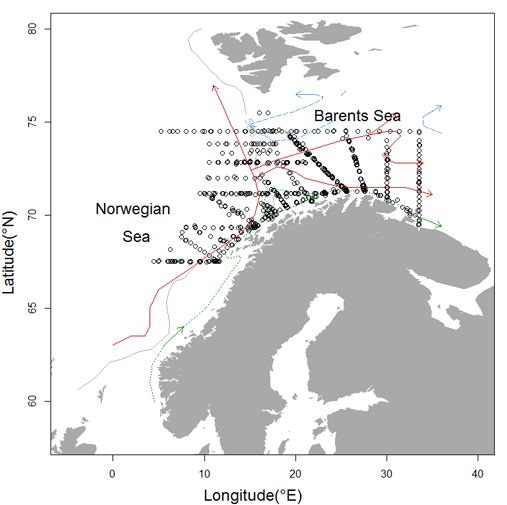
It is notoriously difficult to estimate mortality rates for zooplankton populations in the open ocean. In a new paper, Kvile and colleagues demonstrate that mortality estimation can be improved using a statistical regression approach (SRA) that takes into account advection and spatiotemporal trends in recruitment. Using this method on Calanus finmarchicus survey data from the Norwegian Sea–Barents Sea, they find indications of increased mortality for the oldest copepodite stage pair (CIV–CV), possibly reflecting higher predation pressure on larger copepodites.
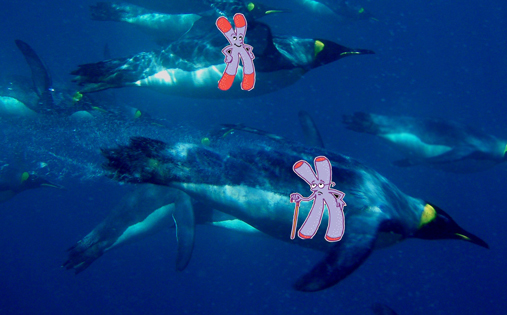
Growing evidence suggests that the telomeres’ length (a non-coding DNA sequence localized at the end of the chromosomes) is related to individual breeding performances and survival rates in several species.
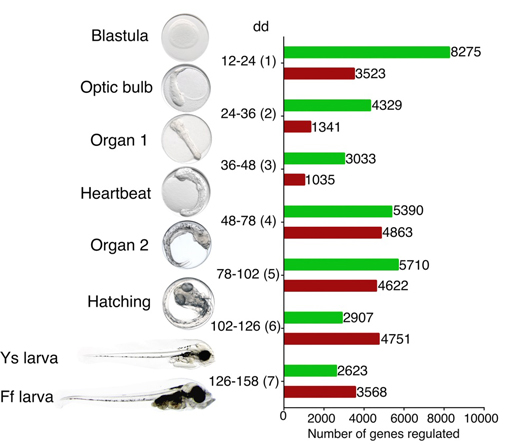
The development of haddock embryos is highly impacted by oil exposure as discussed in a previous post. In a new study Sørhus et al. explored the link between transcriptional changes and developmental processes such as pattern formation and organogenesis. The question is to understand the abnormal development in fish.
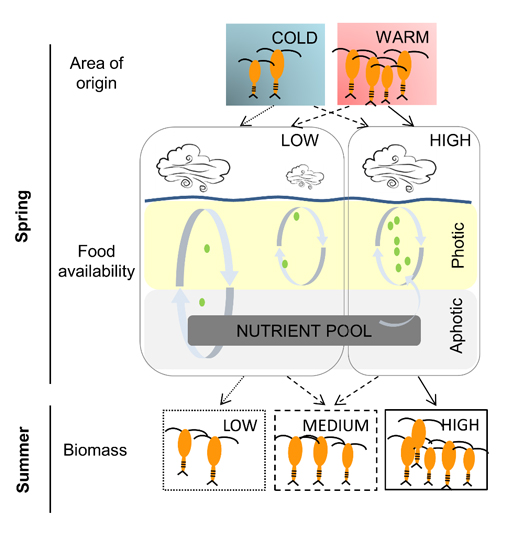
A recently paper published in PNAS, members of the CEES Marine Group explore potential climate effects on Calanus finmarchicus, a key zooplankton species in the North Atlantic. The paper shows how the combination of shallow mixed-layer-depth and increased wind apparently increases chlorophyll biomass in spring, and in turn C. finmarchicus biomass in summer. These findings strongly suggest bottom-up effects of food availability on zooplankton, and highlight the need to consider climate effects “beyond temperature” when projecting zooplankton dynamics under climate change.
Marine phytoplankton contribute nearly 50% to global primary production, support zooplankton production and play a vital role in regulating Carbon sequestration. Phytoplankton productivity fluctuations are caused by various direct and indirect effects of temperature, the balance of which show large-scale geographical patterns.
Friday 11 December 2015, Kristina Øie Kvile has defended her PhD about the climate effects on Calanus finmarchicus dynamics with success.
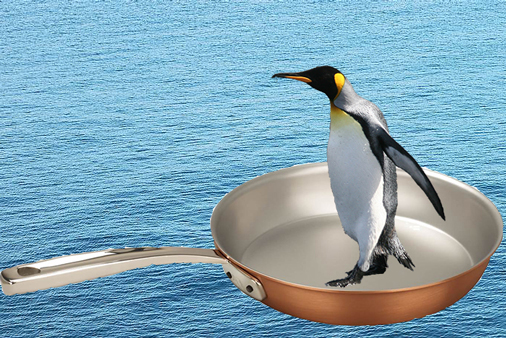
Penguins are highly visible species for the public. Their life has been portrayed in many movies. Unfortunately they are also species impacted by climate change. In a recent publication a team led by Charles Bost used long-term data to relate the large-scale climatic anomalies in the Southern Hemisphere to the foraging behaviour and population dynamics of the king penguin.